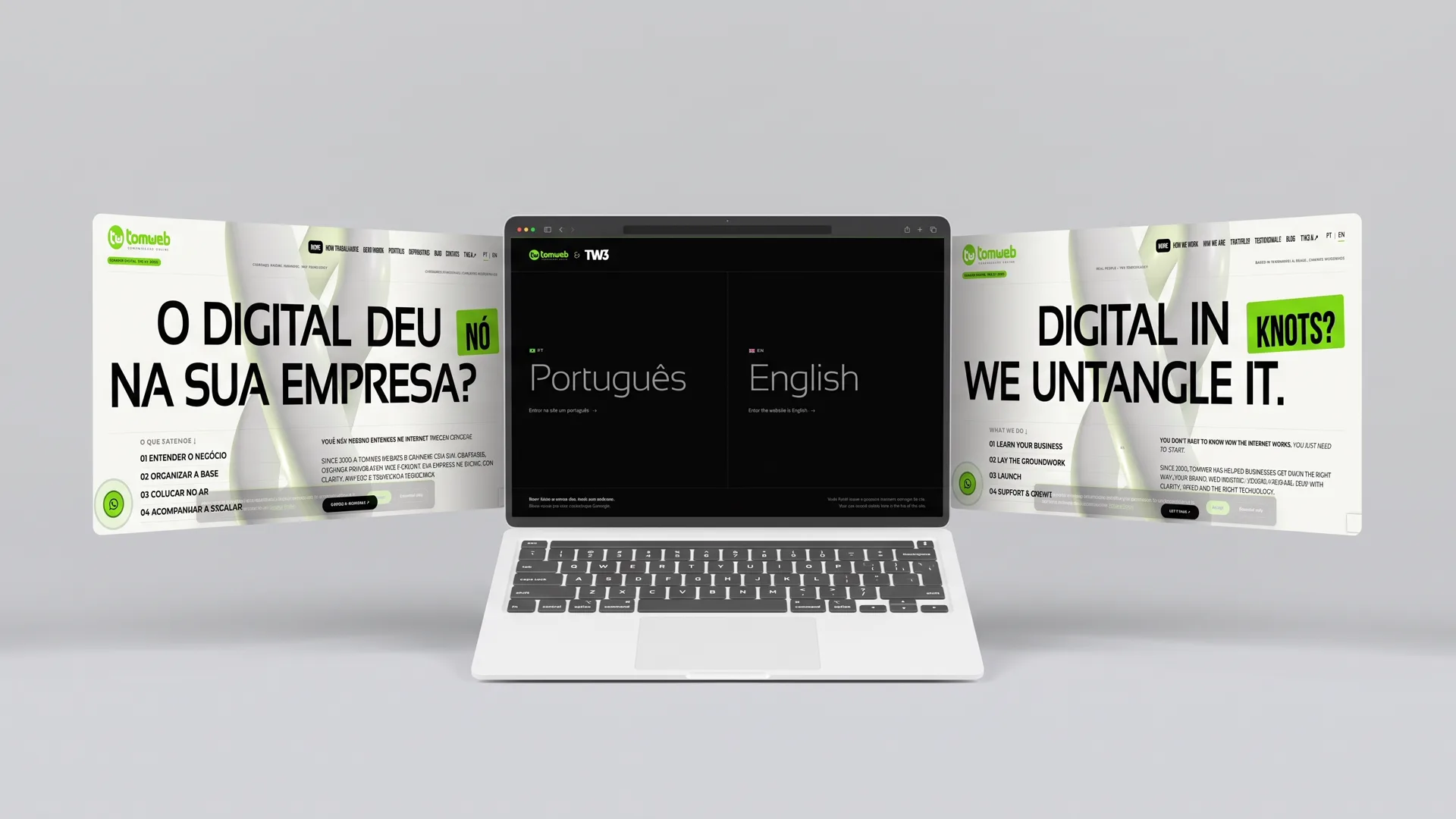
The Tomweb website is now bilingual. Visitors pick Portuguese or English on an entry screen, we remember the choice in the browser, and a PT | EN switch stays visible at the top of every page, so you can change language at any time. Every Portuguese page has an English counterpart, and the switch always takes you to the matching page, never just back to the homepage.
The English is not a translation. Word-for-word translation gives you text that is correct but has no voice, and an American reader notices within two lines. We rewrote the content for a U.S. audience: a different rhythm, different expressions, a different way of presenting what Tomweb does. Our Portuguese homepage line, “O digital deu nó na sua empresa?”, became “Digital in knots? We untangle it.” Same idea, written the way English speakers actually talk.
The entry screen is an overlay on the page, not a separate page, and search engine bots never see it, so Google keeps reading the site as usual. The English address, tomweb.com.br/en/, is indexable, each page declares its language (lang), and hreflang tells search engines how the two versions relate, so each language reaches the right audience.
The care goes beyond the copy. In English, the cookie notice, the privacy policy, the form messages and the chat bubble are all in English too. The Libras accessibility tool only applies to Brazilian Portuguese, so it does not load on the English side. We built all of it without a language plugin, using our own templates and URL-based conditions, which keeps the site light on the hosting.
This is the kind of project Tomweb and TW3 deliver: design, development and content working together. If your business is run by Brazilians abroad, or is a company that does business with Brazil, a site that sounds natural in both languages builds real trust. Visit tomweb.com.br and choose your language.