Updated on October 29, 2026. This article grows over time: the change log is at the end.
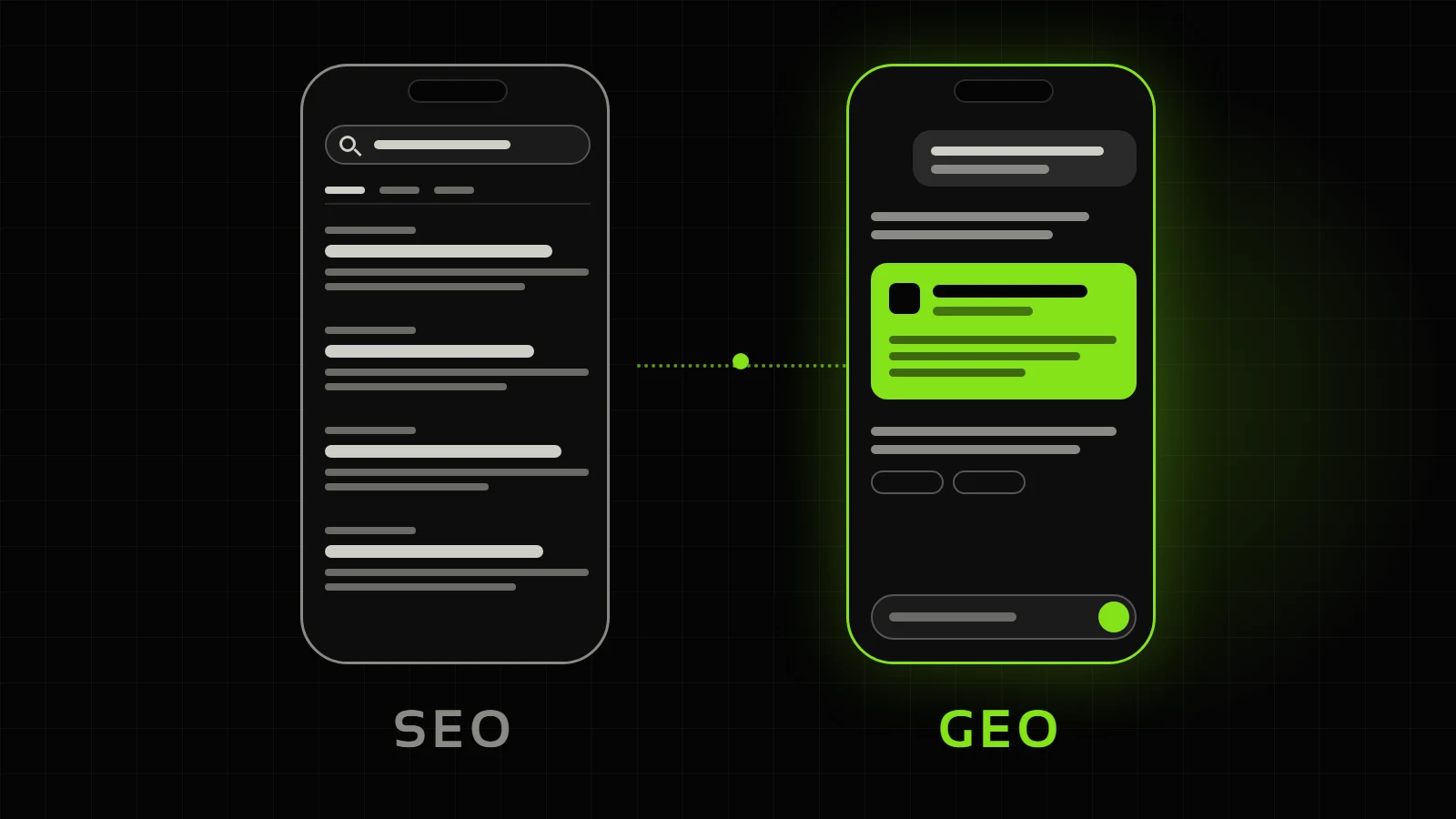
Have you heard of SEO (Search Engine Optimization)? It is the set of practices that makes a website show up on Google, and it is still very much alive. But today many people do not even open Google: they ask ChatGPT, Gemini or Google’s AI which is the best restaurant, the best clinic or the best agency in town. And they get a ready-made answer with one to three names, instead of ten links.
You can be first on Google and still be missing from that answer. This article explains why and what to do about it, in plain language.
What GEO is
GEO stands for Generative Engine Optimization: making your business easy for AI tools that answer questions to understand and to cite. The term is not new. It came out of a study by researchers at Princeton, Georgia Tech and IIT Delhi, published in 2023 and presented at the KDD conference in 2024.
The study showed that text with data, sources and specific information gains more visibility in AI answers, with gains of up to 40% in the tests. That is a ceiling, not a promise: the authors themselves say effectiveness varies by field. In practice, the website has to say clearly what the business does, where it operates and why it can be trusted, in sentences that are easy to quote.
SEO and GEO: what stays and what changes
Classic SEO is the foundation, and Tomweb builds websites that way: clear titles and copy, speed, a mobile version, a structure Google understands. GEO is the new layer on top. The two help each other: what makes a page clear to Google also makes it easy for an AI to quote.
One honest note: Google itself says there is no extra requirement, and no special markup, to appear in its AI features. The page only needs to be indexed and eligible to show up in search. In other words, there is no trick: there is a well-built website, clear content and presence in more than one place.
Each AI searches a different source
AI tools do not read the same internet. Claude uses Brave Search to look things up on the web. Gemini uses Google. ChatGPT has its own paths, and the exact origin of its answers is not fully disclosed. That is why ranking first on Google does not guarantee showing up in every answer. The way forward is to appear on more than one search engine, not only Google.
All of them prefer pages that answer directly: a question in the headline and the answer right below it, in a few lines. The easier you are to quote, the better the chance your name makes it into the answer.
Technical checklist: let the AI robots in
Many websites block these robots without knowing it, in the robots.txt file, the firewall or the CDN. These are the ones that matter, according to each company’s official documentation:
- OAI-SearchBot (OpenAI): brings your site into ChatGPT search. If it is blocked, the site stops appearing in ChatGPT search answers. OpenAI recommends allowing it.
- GPTBot (OpenAI): collects content that may be used to train models. Blocking it does not affect ChatGPT search. That is the site owner’s decision.
- Claude-SearchBot and Claude-User (Anthropic): the first indexes content for Claude’s searches, the second visits pages when someone asks Claude a question. Turning either off may reduce your visibility in answers.
- ClaudeBot (Anthropic): collects content for training. Also the site owner’s decision.
- Googlebot: Google’s robot. The page must be indexed and eligible to appear with a snippet in search to be used in Google’s AI features.
Example robots.txt snippet that allows the AI search robots:
User-agent: OAI-SearchBot
Allow: /

User-agent: Claude-SearchBot
Allow: /

User-agent: Claude-User
Allow: /
Also check the firewall and the CDN, which can block these robots even when robots.txt allows them. Keep important content as text (not only in images), with internal links between pages, and use structured data only when it matches what is written on the page.
Write in answer form
AI tools build answers. The more your page already looks like an answer, the easier it is to use. The recipe is simple:
- Use the question your customer asks as the headline, in their own words. Example: “How long does it take to build a website?”.
- Answer right below, in two or three lines, with no detour. Then go deeper.
- Bring data, sources and specific information, such as city, timelines and how the service works.
- Say clearly what the business does, where it operates and why it can be trusted.
Reputation beyond your website
The website alone is not enough, though. AI relies heavily on what others say about you: reviews, your Google Business Profile, press coverage, directories and social media. For a local business, GEO is largely good local SEO. Google also recommends keeping the Business Profile up to date. And all of it adds to your SEO: Google, social media and your website work together, not apart.
How to test whether your name appears
- List five to ten questions your customers ask, such as “what is the best [specialty] clinic in [city]?”.
- Ask each one on ChatGPT, Gemini, Claude and Google’s AI.
- Note whether your name appears, in what position and which competitors are cited.
- Repeat every month and compare. Answers vary from one try to the next, so the trend is what counts, not a single test.
In Google Search Console, traffic coming from Google’s AI features shows up alongside the web search performance report.
Common mistakes
- Blocking the AI search robots without noticing.
- Thinking that ranking first on Google solves everything.
- Writing generic text, with no data, no city, no proof.
- Promising guaranteed results: nobody controls what an AI will answer.
- Creating “magic” files and tricks expecting a miracle. Google says it needs no special file for its AI features.
Frequently asked questions
Does GEO replace SEO?
No. SEO is the foundation and still matters. GEO is the layer that makes your business easy for AI to cite.
Does blocking GPTBot remove my site from ChatGPT?
No. According to OpenAI, GPTBot is for training and ChatGPT search depends on OAI-SearchBot. Blocking OAI-SearchBot removes you from search answers.
Do I need an llms.txt file?
Google says it needs no special text files to appear in its AI features. We found no official confirmation that other AI tools depend on that file. Take care of the basics first.
Does it work for a local business?
Very much. When someone asks for the “best [service] in [city]”, reviews, your Google profile and clear information about where you operate weigh heavily.
How Tomweb helps
That is what Tomweb does for your business: a website built for Google and for AI, with accessibility features so that everyone can use it, a complete Google profile, organized reviews and content worth citing. We start with a diagnosis: we test the questions your customers ask AI and show you whether your name appears. Comment GEO on our Instagram (@tomwebdigital) or message our team on WhatsApp (48) 99802-3006. In-person service in the Greater Florianópolis area.
Sources
- GEO: Generative Engine Optimization (Aggarwal et al., KDD 2024)
- OpenAI: OAI-SearchBot, GPTBot and ChatGPT-User robots
- Anthropic: ClaudeBot, Claude-User and Claude-SearchBot robots
- Google: AI features and your website
Update history
- October 29, 2026: expanded article, with each AI’s source, technical checklist, how to write in answer form, testing your name, common mistakes and FAQ.
- October 28, 2026: article published.